Kashmir Great Lakes Trek


Tour Itinerary
Day 1: Srinagar to Shitkadi Campsite
- Your journey into the Himalayas begins with your arrival at Srinagar Airport, where our team will receive you and begin the drive towards Shitkadi, the starting point of the Kashmir Great Lakes trek.
- The road gradually leaves the city behind and winds through the beautiful Sindh River Valley, one of the most scenic routes in Kashmir.
- The drive takes approximately 3–4 hours and passes through charming mountain villages, alpine forests, and stunning views of the Sindh River, a major tributary of the Jhelum.
- As you approach Sonmarg, the landscape begins to transform into wide meadows surrounded by snow-capped peaks.
- From Sonmarg, it’s a short drive to Shitkadi, where your campsite awaits.
- After checking in, take some time to relax, soak in the mountain air, and prepare for the adventure ahead.
- The evening is perfect for meeting fellow trekkers and enjoying the peaceful surroundings of the Himalayas.
- Overnight stay at Shitkadi Campsite.
Day 2: Shitkadi to Nichnai
- The trek begins today with an exciting start as you leave the campsite and head towards Nichnai, walking through some of the most picturesque landscapes in the region.
- The trail initially climbs gradually and offers beautiful views of the Thajiwas Glacier and surrounding valleys.
- As you gain altitude, the path leads into the enchanting Bhoj forests, filled with tall birch trees that create a magical canopy along the trail.
- The route then opens into vast alpine meadows dotted with grazing sheep and flowing mountain streams.
- These peaceful meadows eventually lead to the stunning Nichnai Valley, where the campsite is located amidst rolling grasslands and towering peaks.
- After reaching the campsite, spend the evening relaxing and enjoying the quiet beauty of the Himalayas.
- Overnight stay at Nichnai Campsite.
Day 3: Nichnai to Vishansar Lake
- Wake up to spectacular views of the mountains surrounding Nichnai Pass, which will be the first major pass of the trek.
- Today’s trail takes you through dramatic landscapes featuring rolling meadows, streams, and high-altitude valleys.
- The ascent towards Nichnai Pass is steady but rewarding, offering panoramic views of the surrounding peaks and valleys.
- After crossing the pass, the trail gradually descends into a beautiful valley filled with vibrant alpine flowers and grazing horses.
- As the trek continues, the landscape slowly reveals one of the highlights of the entire journey- the breathtaking Vishansar Lake.
- Set against the backdrop of towering mountains, this glacial lake is known for its crystal-clear waters and serene surroundings.
- Spend the evening exploring the lakeside and soaking in the beauty of this high-altitude paradise.
- Overnight stay at Vishansar Campsite.
Day 4: Vishansar Lake to Gadsar
- Today is one of the most scenic and adventurous days of the trek.
- Wake up to mesmerizing morning views of Vishansar Lake before beginning the hike toward Kishansar Lake, another pristine alpine lake located just above Vishansar.
- From Kishansar, the trail climbs steadily towards Gadsar Pass, the highest point of the trek at around 13,800 ft.
- The climb rewards trekkers with stunning panoramic views of multiple alpine lakes scattered across the valley.
- After crossing the pass, the trail begins a descent towards the picturesque Gadsar Valley.
- Along the way, you may also spot the serene Yamsar Lake, tucked quietly between the mountains.
- By evening, you will arrive at the Gadsar campsite, surrounded by dramatic mountain scenery and untouched alpine wilderness.
- Overnight stay at Gadsar Campsite.
Day 5: Gadsar to Satsar Lakes
- Today’s trek takes you through a landscape filled with countless streams, vibrant meadows, and wide mountain valleys.
- The trail gradually climbs towards Magnum Top, offering breathtaking views of the surrounding Himalayan ranges.
- As you walk further, the terrain becomes greener and more expansive, eventually opening into the beautiful Satsar Meadows.
- “Satsar” literally means seven lakes, and this region is known for its cluster of alpine lakes hidden within the valley.
- The peaceful surroundings and wide grasslands make this one of the most beautiful campsites on the trek.
- Enjoy a quiet evening surrounded by mountains and star-filled skies.
- Overnight stay at Satsar Campsite.
Day 6: Satsar to Gangabal
- Wake up to a magical Himalayan morning near the Satsar Lakes before beginning the trek towards the final highlight of the journey- the magnificent Gangabal Lake.
- The trail today includes a scenic ridge walk that offers incredible views of surrounding valleys and distant peaks.
- As you descend, the massive Harmukh Peak begins to dominate the skyline.
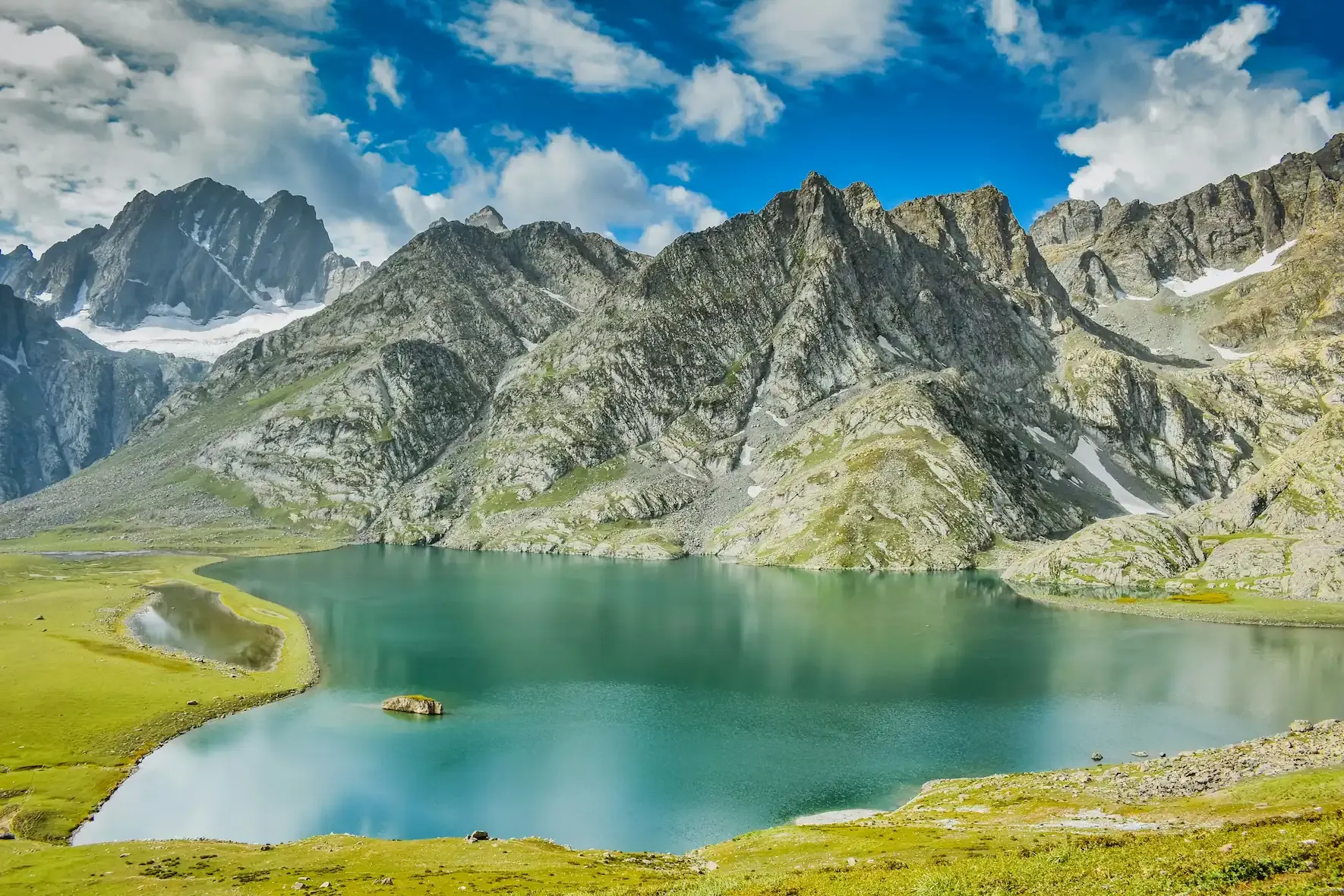
- At the base of this towering mountain lie the stunning twin lakes of Gangabal and Nundkol, considered among the most beautiful alpine lakes in Kashmir.
- Their deep blue waters reflect the surrounding peaks, creating a breathtaking sight.
- After reaching the campsite near Gangabal Lake, spend the evening exploring the area and enjoying the peaceful atmosphere.
- Overnight stay at Gangabal Campsite.
Day 7: Gangabal to Naranag | Drive to Srinagar
- Your final day begins with a stunning sunrise over Gangabal and Nundkol Lakes, one of the most memorable moments of the trek.
- After breakfast, begin the descent towards Naranag, walking through beautiful alpine meadows and gradually entering forested trails lined with pine trees.
- As the altitude decreases, the terrain becomes greener and more lush, marking the end of the high-altitude trek.
- Upon reaching Naranag, vehicles will be waiting to take you back to Srinagar, a drive of approximately 2 hours.
- With memories of pristine lakes, high mountain passes, and the breathtaking landscapes of Kashmir, your Kashmir Great Lakes trek comes to a memorable conclusion.
Includes:
- Airport pickup and drop from Srinagar Airport.
- Veg food (6 breakfast, 6 packed lunch, 6 dinner).
- Stay in tents (6 nights camping) with sleeping bags.
- All trekking permits.
- Experienced trek leader and local support team throughout the trek
- Basic medical assistance and emergency support during the trek
- Camping equipment including high-quality tents, mattresses and dining tents
- Forest entry fees and environmental charges
- Safety equipment including first aid kit, oxygen cylinder and oximeter
Excludes:
- Food & stay of buffer day (if required).
- GST (5% or as applicable).
- Porter/ Mules or any backpack offloading charges & other expenses.
- Any medical emergency or mishap expenses.
- Any cost arising out of unforeseen circumstances, including medical emergencies and acts of God.
- Extra days' stay/ food at any place during the tour because of bad weather or road blocking due to snow.
- Anything that is not mentioned in the above list of inclusions.
About the Trip
The Kashmir Great Lakes Trek is a 6-night, 7-day Himalayan trekking experience that takes you from Srinagar towards the alpine landscapes around Sonamarg and eventually down to Naranag. Unlike a conventional Kashmir sightseeing trip, this journey is experienced on foot, with consecutive trekking days through forests, open meadows, mountain passes and high-altitude lake regions. The route combines the changing landscapes of the Kashmir Himalayas with six nights of camping, making the trail itself as important as the destinations along the way.
The trek begins at Shitkadi after the drive from Srinagar and gradually moves into higher mountain terrain. As the route progresses, trekkers encounter Nichnai, Vishansar, Kishansar, Gadsar, Satsar, Gangabal and Nundkol before descending towards Naranag. The landscape changes noticeably along the way, from forested sections and broad meadows to exposed high-altitude terrain and lakes surrounded by mountain ridges. Kashmir Tourism also identifies the Sonamarg–Naranag Great Lake route and the Naranag–Gangabal trail among the region's established trekking routes.
The experience is physically more demanding than a regular holiday in Kashmir because the itinerary involves several consecutive days of walking, altitude gain and descent, camping and changing trail conditions. The route reaches its highest section around Gadsar Pass, listed on the current itinerary at approximately 13,800 feet. Travellers should therefore prepare for sustained walking rather than viewing the trip simply as a collection of scenic viewpoints. The exact experience can vary with weather, trail conditions and local operating decisions.
What makes this trek distinctive is the progression between different mountain environments. The route does not stay around one lake or campsite; it gradually moves through valleys, passes and alpine landscapes before reaching the Gangabal and Nundkol area beneath Harmukh. For trekkers who want to experience Kashmir through a multi-day mountain route rather than a road-based itinerary, the journey provides a structured combination of trekking, camping and high-altitude landscapes.
A Trek Through Kashmir's Changing Mountain Landscapes
One of the defining characteristics of the Kashmir Great Lakes Trek is the variety of terrain encountered over the seven-day route. The lower sections include forested trails and greener valleys, while the higher sections open into broad alpine meadows, rocky passes and exposed mountain landscapes.
The route also changes visually as altitude increases. Birch forests give way to open meadows, and streams and valleys gradually lead towards the high-altitude lake systems. Vishansar and Kishansar are among the major lakes on the route, while Satsar represents a group of alpine lakes and Gangabal and Nundkol form the final major lake landscape before the descent to Naranag. Kashmir Tourism describes Vishansar and Krishansar as high-altitude alpine lakes and Gangabal as an alpine lake at the foot of Mount Haramukh.
This variety is important when preparing for the trek. A trail that feels comfortable in a meadow or forest can feel very different on a steeper ascent or exposed section. Trekkers should therefore expect changing walking conditions rather than a uniform trail throughout the journey.
Trek Difficulty, Terrain and Physical Preparation
The Kashmir Great Lakes Trek should be approached as a genuine multi-day Himalayan trek rather than an easy nature walk. The itinerary includes repeated walking days, climbs towards mountain passes, descents into valleys and camping at higher elevations. The combination of distance, altitude and consecutive trekking days makes physical preparation important.
Trekkers should ideally prepare by building their walking endurance before departure. Regular walking, uphill and downhill training, stair or incline workouts and practice with a daypack can help prepare the body for consecutive days on the trail.
You should also be comfortable with:
- Walking for several hours on consecutive days
- Uneven and sometimes rocky mountain trails
- Sustained uphill and downhill sections
- Carrying a personal daypack
- Walking in changing weather conditions
- Camping in mountain environments
- Maintaining a steady pace rather than rushing uphill
Previous Himalayan trekking experience can be useful, but preparation remains important even for travellers who are new to multi-day trekking.
Understanding Altitude on the Trek
Altitude is an important part of the Kashmir Great Lakes experience. The route progressively moves away from the lower valley towards high-altitude camps and mountain passes, with Gadsar Pass representing the highest section of the itinerary at approximately 13,800 feet. Official Kashmir Tourism information places Vishansar and Krishansar around 3,800 metres and Gangabal around 3,570 metres, illustrating how significantly the terrain rises above the Kashmir Valley.
At higher elevations, physical exertion can feel more demanding than it does at lower altitudes. A steady pace, adequate hydration, appropriate rest and attention to how you are feeling are important throughout the trek. Trekkers should communicate any concerning symptoms to the trek leader rather than trying to push through them.
The package currently includes basic medical assistance, emergency support, a first-aid kit, oxygen cylinder and oximeter, along with an experienced trek leader and local support team. These arrangements provide support during the trek but should not be treated as a substitute for sensible preparation or professional medical advice where required.
What Camping Is Like on the Kashmir Great Lakes Trek
Camping is a central part of this experience rather than simply an overnight alternative to hotels. The current package includes six nights of camping, sleeping bags, tents, mattresses and dining tents. Meals during the trek include six breakfasts, six packed lunches and six dinners, with vegetarian food specified in the inclusions.
Travellers should therefore expect mountain-camp facilities rather than hotel-style accommodation. Personal comfort will depend partly on weather, campsite conditions and how prepared you are with appropriate clothing and personal essentials.
The camping environment is also part of the attraction of a high-altitude trek. Instead of returning to a city or resort each evening, the group remains close to the trail and spends the night in the mountain landscape before continuing the route the following day.
The High-Altitude Lakes and Mountain Passes
The lakes are the central visual feature of the route, but the experience is shaped equally by the passes and valleys connecting them. Vishansar and Kishansar appear during the middle portion of the trek, followed by the climb towards Gadsar Pass and the descent towards Gadsar Valley.
Gadsar Pass is particularly important because it represents the highest point listed in the current itinerary. The route then continues towards Satsar, where the landscape opens into broad alpine meadows containing a group of lakes. The term “Satsar” is traditionally associated with seven lakes, although the number of visible water bodies can vary depending on seasonal conditions.
The final major lake section is around Gangabal and Nundkol beneath Mount Harmukh. Kashmir Tourism identifies Gangabal as an alpine lake at the foot of Harmukh and describes the Naranag area as an important base for treks towards Gangabal.
Weather and Seasonal Conditions
Mountain weather can change quickly, and conditions on a high-altitude trek should not be treated in the same way as weather in Srinagar. Rain, cold temperatures, wind or lingering snow can affect trail conditions and walking comfort, while local conditions can influence how the trek is operated.
For this reason, trekkers should carry appropriate layers and rain protection and remain flexible about exact trail conditions. The current package also states that additional costs may arise from weather-related delays, road blockages or circumstances requiring extra accommodation or food, while a buffer-day stay and food are excluded from the package.
Kashmir Tourism identifies summer as an established trekking period in the region, while specific high-altitude routes and lakes can have different seasonal conditions. Gangabal, for example, is described by Kashmir Tourism as remaining frozen from November to April. Actual trek dates should therefore be planned around the operating season and current trail conditions rather than relying only on a fixed calendar assumption.
Trek Support, Permits and Safety Arrangements
The current package includes several operational elements that are important for a multi-day trek. These include trekking permits, forest entry and environmental charges, an experienced trek leader, local support, camping equipment and basic safety equipment.
The safety equipment listed on the package includes a first-aid kit, oxygen cylinder and oximeter, while basic medical assistance and emergency support are also included. Trekkers should still carry their own regular medication and inform the trek team about relevant requirements before departure.
Local conditions can sometimes require changes to the planned route or schedule. Trek leaders and local support teams can make practical decisions based on trail, weather and operational conditions, so travellers should be prepared to follow instructions rather than treating the itinerary as an inflexible timetable.
Preparing for the Kashmir Great Lakes Trek
Good preparation can make the difference between simply completing the route and being able to enjoy the landscapes along the way. Start building walking endurance several weeks before the trek and include uphill and downhill training where possible.
A practical preparation checklist includes:
- Trekking shoes with reliable grip
- Warm and lightweight layers
- Waterproof jacket or rain protection
- Thermal layers for colder conditions
- Comfortable trekking trousers
- Warm socks and gloves
- Sun protection and sunglasses
- Sunscreen and personal toiletries
- Reusable water bottle
- Headlamp
- Power bank
- Personal medication
- Government-issued identification
- Small personal daypack
Shoes should be properly broken in before the trek. It is also useful to keep rain protection and warm layers accessible during the day rather than packing them deep inside your luggage.
Food and Daily Trekking Requirements
The package includes vegetarian meals throughout the planned six nights and seven-day itinerary, with six breakfasts, six packed lunches and six dinners. Lunches are packed for the trail, while breakfast and dinner are provided around the campsites.
Travellers should remember that this is trekking food rather than hotel dining. The priority is practical nourishment during physically demanding days, so expectations should be set accordingly.
Personal snacks and any specific dietary requirements should be discussed with the trip team before departure rather than assumed to be included. The package excludes anything not specifically mentioned in the inclusions.
From Gangabal to Naranag
The final trekking day changes the character of the landscape again. After spending the previous night around Gangabal, the route descends towards Naranag, gradually moving from higher alpine terrain towards greener and more forested surroundings. The current itinerary then provides a vehicle transfer from Naranag back to Srinagar.
Naranag is more than simply the point where the trek ends. Kashmir Tourism identifies the village as an important trekking base for Gangabal and notes its historic temple remains and surrounding deodar forests. This gives the final section of the journey a transition from high-altitude trekking to the cultural and lower-elevation landscapes of Kashmir.
Who Should Consider This Trek?
The Kashmir Great Lakes Trek is suited to travellers who want a genuine multi-day Himalayan trekking experience rather than a conventional Kashmir holiday. It is particularly relevant for people interested in alpine lakes, mountain passes, meadow landscapes, camping and extended time outdoors.
It can suit both experienced trekkers and prepared first-time multi-day trekkers, provided they understand the physical demands involved. The important consideration is not simply previous trekking experience but whether you are prepared for consecutive walking days, altitude, camping and changing mountain conditions.
This trek may not be the right format for travellers who primarily want comfortable hotels, short sightseeing walks or a road-based Kashmir itinerary. The experience requires active participation throughout the trekking section and a willingness to adapt to mountain conditions.
What to Realistically Expect
The Kashmir Great Lakes Trek is not a luxury holiday in the mountains. Six nights are spent camping, several days involve extended walking and the route reaches high elevations. You should expect tired legs, changing weather, basic campsite facilities and days when the trail feels more demanding than expected.
At the same time, the trek provides a level of access to Kashmir's alpine landscapes that cannot be experienced from a vehicle. The progression from forest and meadow terrain to high-altitude lakes and mountain passes is what gives the journey its character.
Weather, trail conditions and other local circumstances can influence the actual experience. The current package specifically excludes additional costs associated with certain unforeseen situations, including weather-related delays, road blockages and medical emergencies. Travellers should therefore approach the trek with some flexibility rather than expecting every element to operate exactly to a fixed timetable.
A Complete Seven-Day Kashmir Trekking Experience
From the drive out of Srinagar to Shitkadi and the first climb towards Nichnai, the journey gradually moves deeper into the Kashmir Himalayas. Vishansar and Kishansar introduce the first major alpine lake landscapes, Gadsar Pass brings the highest section of the route, Satsar opens into a broad lake-filled meadow environment, and Gangabal and Nundkol provide the final high-altitude landscape before the descent to Naranag.
The value of this trek lies in that progression. Rather than visiting one scenic location and returning to a hotel, you spend several days moving through changing terrain and camping along the route. For travellers prepared for the physical demands of high-altitude trekking, the Kashmir Great Lakes Trek offers a structured way to experience the region's alpine lakes, meadows, mountain passes and remote landscapes on foot.
- 30+ days before: 50% of trip cost
- 15-30 days before: 75% of trip cost
- 0-15 days before: 100% of trip cost
- Within 30 days: No date changes allowed
- Before 30 days: Free for domestic trips
Key Points
Booking amounts are non-refundable for cancellations.
Trip date changes have specific conditions (see below).
Cancellation Charges
Rescheduling
Force Majeure
No refunds for weather/government issues - alternate activities may be offered.
- Personal details (name, email, phone, payment info)
- Travel preferences to customize services
- Website usage data (IP address, browser type)
- Communications with us
- To provide and improve our services
- For personalized travel experiences
- Marketing (with consent)
- Legal compliance
- With trusted service providers
- When legally required
- During business transfers
Overview
We protect your privacy and secure your personal information. This policy explains how we collect, use, and safeguard your data.
Data Collection
Data Usage
Data Sharing
Your Rights
You can access, correct, or delete your data. Opt-out of marketing anytime.
Security
We use industry-standard measures to protect your information.
Contact & Full Policy
For complete details, please visit our full Privacy Policy page.
Contact us at: info@deshvideshtravels.com
